In this article
LLM is the acronym you encounter everywhere when the conversation is about AI, but few get a proper explanation of what it actually is. Most people think it "Googles" — that's not entirely wrong, but it's not entirely right either, and the misunderstanding has practical consequences for how you approach AI visibility.
What is an LLM?
LLM stands for Large Language Model. It's the technology behind the AI tools you hear about everywhere: ChatGPT from OpenAI, Gemini from Google, Claude from Anthropic, and many others.
An LLM is fundamentally a very advanced guessing machine. It has read enormous amounts of text from the internet, books, and articles, and has learned one basic pattern: given a sequence of words, what is the most likely next word? Not because it understands meaning as we do, but because it has seen enough text to recognise patterns very precisely.
What makes modern LLMs special is not that they are smarter than the simple description above, but that they are trained on so much data and with so many parameters that the pattern recognition becomes extremely sophisticated. They can reason, summarise, translate, and write code — not because they think, but because they have seen enough examples of these tasks being done.
This is also why they sometimes make mistakes with great confidence. When the model doesn't have enough patterns to go on, it still guesses, and the guess can sound just as convincing as when it's right.
So, does an LLM Google or not?
Here's the common misunderstanding, and it's worth clearing up properly.
The base model is an LLM without internet access. It operates solely from what it was trained on: enormous amounts of text processed and stored as mathematical representations. No live search, no web browser, no real-time data. It knows what it has learned, and guesses from there.
The model with tools is a different matter. ChatGPT with browsing enabled, Perplexity, and similar tools can retrieve live information from the web. But that's a layer on top of the LLM, not an inherent property. When that happens, it's not the model "Googling" — it's a tool the model uses, and the result is fed back to the model as text.
Semrush analysis of over one billion lines of clickstream data shows that ChatGPT activates its search function for 34.5 percent of queries as of February 2026, down from 46 percent in late 2024. This means that for the majority of queries, what you asked, and the quality of what is available on the topic, determines whether the model knows the answer.
How an LLM finds information: vectors and semantic search
Here's the part most people never get properly explained, and it suddenly makes a lot of other things more understandable.
Words are not stored as text. They are stored as coordinates.
Imagine a giant space with millions of floating points. Each word, each concept, has its own position in this space, and the position is not random. It is determined by the context in which the word typically appears.
"Dog" and "puppy" float right next to each other. "Dog" and "asphalt" are in different corners. "Interest" is placed somewhere near "bank" when it comes to finance, and somewhere else near "garden" when it comes to plants. Same word, different placement depending on the surrounding context.
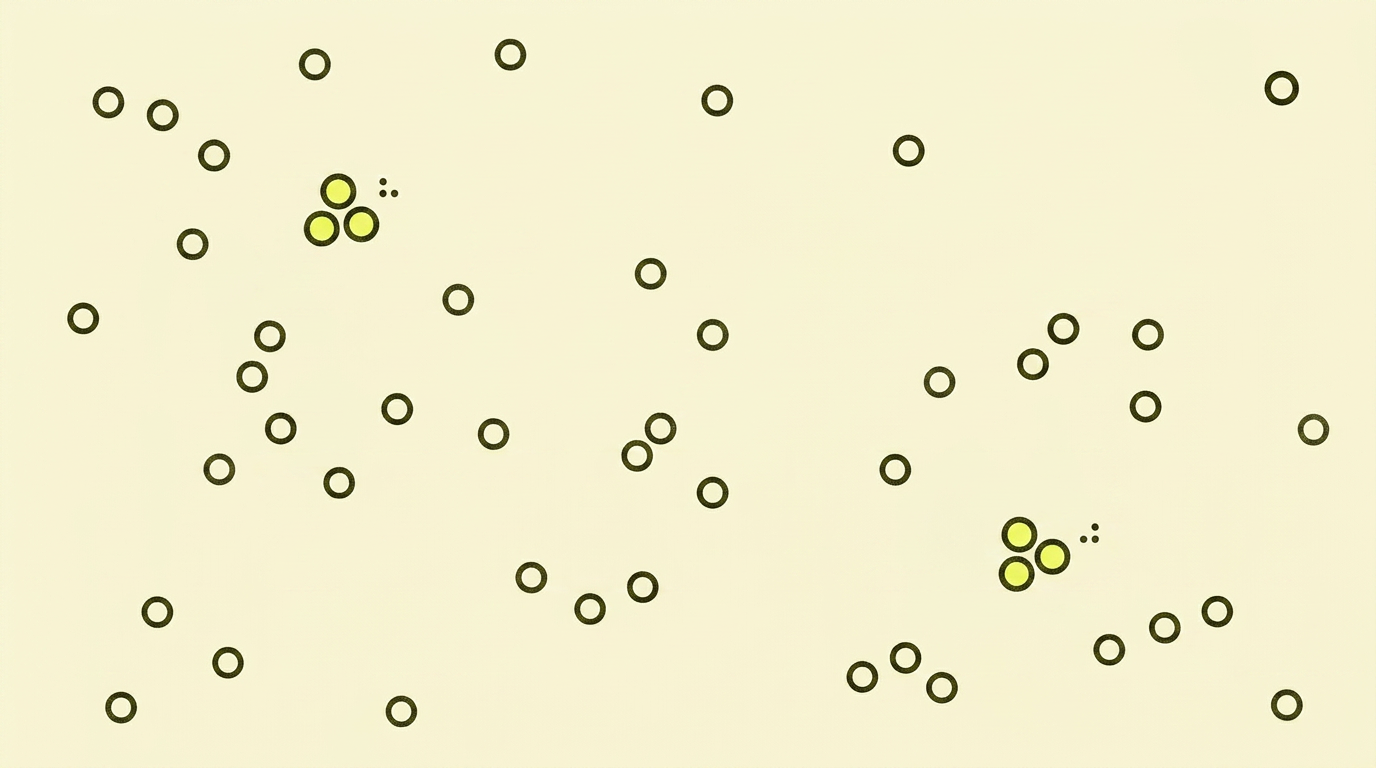
According to OpenAI's technical documentation, embedding models typically have between 1,536 and 3,072 dimensions — far beyond what a human can imagine. But the principle is the same: proximity in space means similarity in meaning.
The search is really a distance calculation
When you ask an LLM a question, your question is converted into a vector — a set of coordinates in the same space. The model then finds the information with coordinates closest to your question's coordinates. It's not a search for letters; it's a search for meaning.
This is why LLMs understand synonyms and context in a way traditional search engines couldn't. A search for "small puppy" finds "tiny canine" because the coordinates are almost identical. A search for "cost reduction" finds "budget savings" for the same reason.
| Search Type | Mechanism | Result for "small puppy" |
|---|---|---|
| Keyword Search | Finds exact text | Finds "small" + "puppy". Misses "tiny dog" |
| Vector Search | Finds closest coordinates | Finds "tiny dog", "little hound", and "puppy" |
When an LLM actually retrieves information: RAG
When ChatGPT with browsing enabled, Perplexity, or a corporate AI solution retrieves external information, it happens through a process called RAG — Retrieval-Augmented Generation.
Simplified, it looks like this:
- Your question is converted into a vector
- The system searches a vector database for the closest coordinates — the most relevant text snippets
- The most relevant snippets are extracted and fed into the LLM as context
- The LLM uses this context to formulate a response
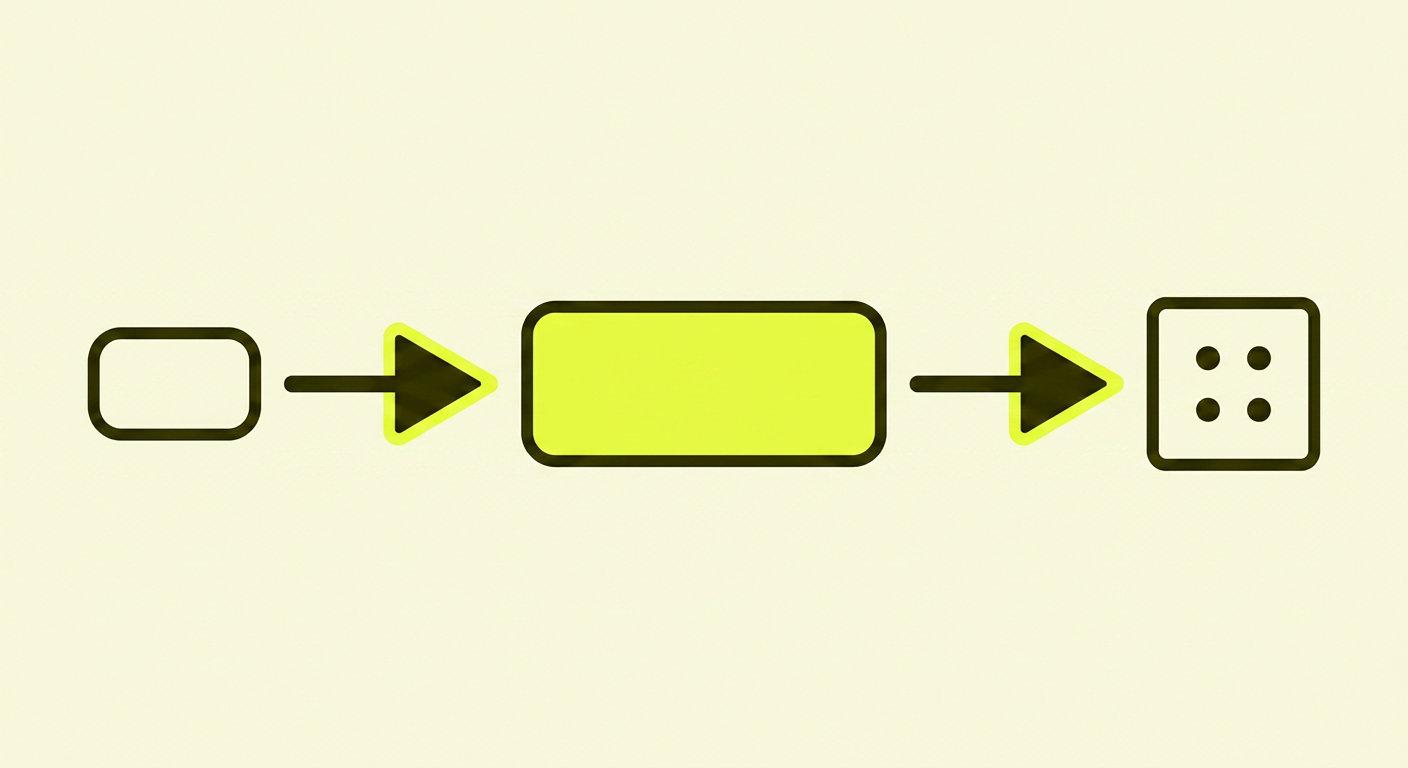
When ChatGPT searches the web, it's essentially RAG with live web as a data source instead of a pre-processed database. The LLM doesn't Google. It is served relevant text snippets based on vector proximity, and uses them to answer.
Bing, Google — or both?
A study by Backlinko in August 2025 challenged the assumption that ChatGPT only uses Bing: they published a page that was only indexed in Google, and ChatGPT provided a correct answer about it despite Bing never having seen the page. ChatGPT thus appears to retrieve from multiple search sources beyond Bing alone, depending on the model and context.
According to Search Engine Land, ChatGPT agents still use the Bing Search API in 92 percent of live searches. This means Bing indexing is still important — but no longer the only thing that matters.
If you want to dig deeper into the practical side of this, I've written an article about what GEO is and how to become visible in AI searches — and a brief overview of llms.txt and whether you actually need it.
What does all this mean for you as a business owner?
The base model retrieves from what it was trained on
For LLMs without live search, visibility is determined by what was available and good enough when the model was trained. Authoritative, consistent, and structured content on a topic has a higher chance of having high vector proximity to relevant questions, and thus a higher chance of being cited.
RAG systems retrieve from what is indexed and available
For live search systems like ChatGPT with browsing and Perplexity, the question is: is your website indexed where the system searches? Based on available data, this means both Bing and Google, but with Bing as the dominant source.
Semantic authority on a topic matters more than individual words
Because LLMs operate with vector proximity, it's not a single keyword that determines if you are a relevant source. It's the combined semantic density of your content around a topic. Ten in-depth articles on one subject provide higher semantic authority than a hundred superficial articles on many topics.
Structured definitions are easier to vectorize and retrieve
A clear, standalone definition early in the text gives the model a precise coordinate point to retrieve from. This is why clear H2s, FAQ sections, and direct answers to specific questions provide better GEO visibility. Not because it's a trick, but because it reflects how LLMs actually operate.
In summary: My opinion
You don't need to understand vectors and RAG to create good content. But it helps to understand that "the LLM Googles" is a simplification that hides something important.
An LLM is not a search engine. It's a meaning-finder. It retrieves what is closest to your question in an enormous mathematical space and formulates an answer based on that. Whether it retrieves it from training data or the live web depends on the mode it's in, not on what you think it's doing.
The consequence is the same regardless: clear, structured, authoritative content on a topic gives you a better position in the space where the LLM is searching. It's no more mysterious than that.
Here you can read more
- ChatGPT traffic analysis — 17 months of clickstream data — the data foundation for the 34.5 percent figures
- ChatGPT Is Using Google Search — We Tested It — documentation that ChatGPT does not exclusively use Bing
- OpenAI: New embedding models and API updates — technical documentation on vector dimensions
- Bing Webmaster Tools — verify your site is indexed for ChatGPT visibility
I stay updated on these sources daily, so you don't have to.