In this article
I regularly get enquiries from new clients who want to "get visible in AI", not as a suggestion for discussion, but as an order.
The irony is that the order usually exists because an AI tool wrote the brief for them in the first place.
When I ask if they actually know what an LLM is, the tool that wrote their brief, or how generative search works in practice, I'm usually met with blank stares.
It's not their fault. The landscape has become complicated very quickly, and most of the explanations out there are either too technical or too simplistic. So here's my attempt at a middle ground.
That's also part of the reason I'm writing this article and the ones that follow. As an organic visibility specialist, it's simply my job to understand the new frontiers of search, not just the one I learned ten years ago.
This series is as much my own learning process as anything else, and I'm sharing it as I go instead of waiting until I feel completely learned, because I don't think any of us will be anytime soon.
In short: a search engine and an LLM don't do the same thing
A search engine like Google retrieves and ranks pages that already exist. It doesn't generate anything itself; it points you to the answer.
An LLM, like ChatGPT or Claude, is trained on vast amounts of text to predict and generate natural language. It doesn't store facts in a database. It has learned patterns and guesses the most likely answer based on what it has been trained on.
This means that an LLM alone often doesn't know what happened yesterday. To answer a current question, it has to search, just like you would, and gather information from the outside before formulating an answer.
This might sound obvious when you read it. But it was new information for absolutely everyone in the room that day.
Google is still winning. But not alone anymore
I've shown the same type of diagram in presentations for years. Google dominates search with around 95 percent, while Bing, Yahoo, and DuckDuckGo share the rest.
That's still true. But it's no longer the whole story.
If you look at all digital searches, not just search engines, around 57 percent still go through Google. But 17.9 percent now go to ChatGPT, up from almost zero three years ago.
This is the biggest shift in search habits in a very long time.
And within the AI category itself, even more is happening. In just one year, ChatGPT's share of chatbot traffic has fallen from 86.7 to 51.3 percent, while Google's Gemini has grown from 5.7 to 27.7 percent. The gap between them has nearly halved in twelve months.
So here's my first point: “who's winning” depends entirely on what question you ask. And most people are asking the wrong question.
Norway looks different from the rest of the world
This is where it gets particularly interesting for those of us working with Norwegian clients.
In Norway, ChatGPT is even more dominant than it is globally. This is how mobile AI chatbot traffic to Norwegian websites breaks down:
The really interesting question: how does an AI model choose a source?
We now know that many AI models search the web to answer current questions. But how do they choose which sources to trust?
The intuition many people have, including myself not too long ago, is that the model just takes Google's top ten and chooses from among them. A kind of double ranking, where Google ranks first and the AI re-ranks what Google finds.
That was much more true a year ago than it is today.
Ahrefs and BrightEdge arrive at slightly different figures, and Ahrefs itself points out that some of the drop is due to their improved measurement methodology, not just a change in Google's behaviour.
Regardless of which figure you choose to trust the most, they all point in the same direction.
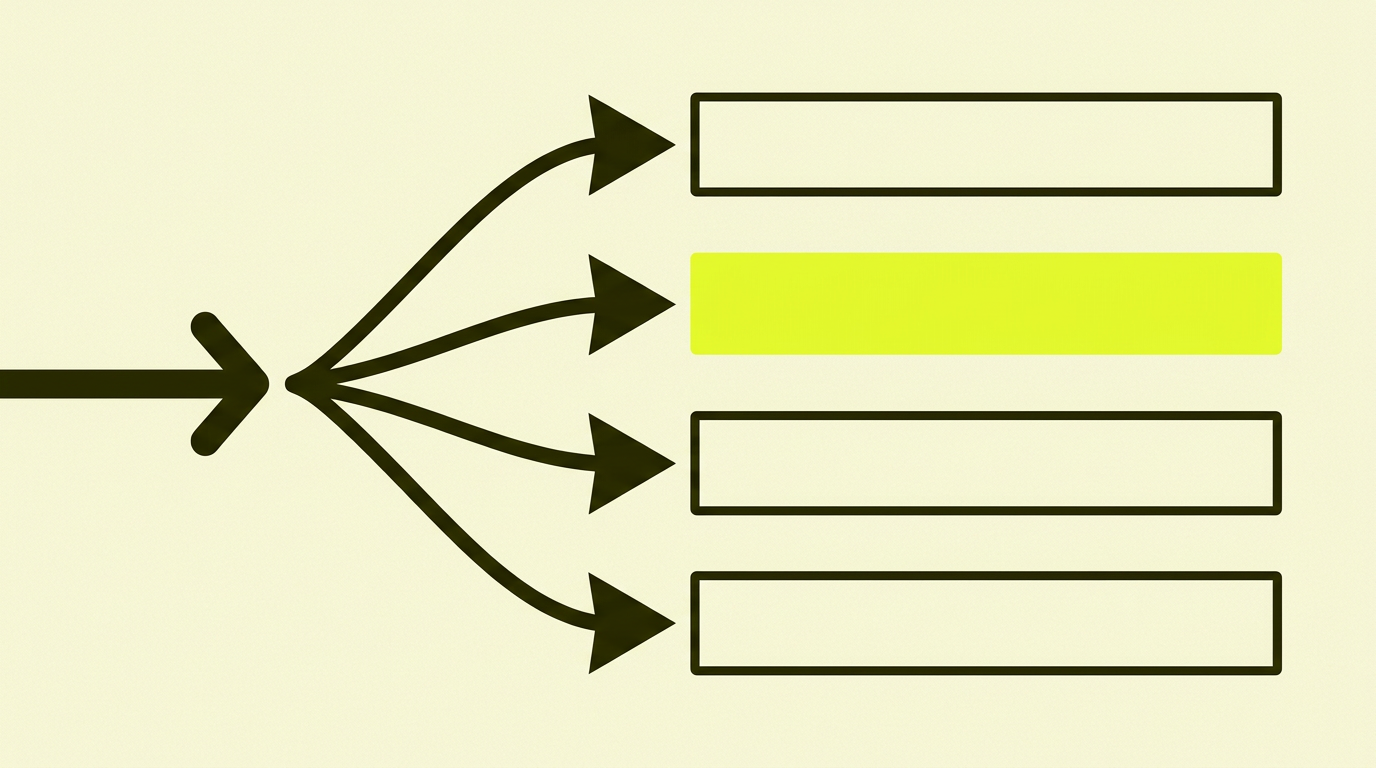
So what do the models do instead? Here I have to be honest that no provider has published the actual algorithm. But the pattern of what actually gets cited points to a few things:
- Query fan-out. Your question is split into many sub-queries, and a page doesn't need to rank high on the main search; it just needs to win one of the sub-queries.
- Semantic matching at the paragraph level, not the whole page. The model looks for precise answers in specific paragraphs, not for which page has the most general authority on Google.
- Consensus across sources. Claims that are repeated and confirmed in multiple places often win over a single “authoritative” page.
- Structure as a filter. Clear headings, one point per paragraph, and direct answers are simply easier for a model to pick up and reproduce correctly.
Each model has its own thing
It's also not the case that all AI models work the same way. They build almost separate source ecosystems.
- ChatGPT favours Wikipedia.
- Perplexity favours Reddit.
- Claude leans towards brand-owned domains and is noticeably cautious about social sources.
Only 13 percent of the domains Claude cites overlap with what ChatGPT cites.
Usage patterns also differ.
- ChatGPT is the most generalist, used for everything from practical advice to writing.
- Gemini is strongest where the user is already in Google's ecosystem.
- Claude leads in coding and is most used in businesses, not by regular consumers.
- Perplexity is mostly used for critical research.
According to Menlo Ventures' latest report, Anthropic now has 40 percent of enterprise LLM consumption, compared to OpenAI's 27 percent. It's worth mentioning that Menlo itself is an investor in Anthropic, but the trend is confirmed by independent consumption data from Ramp.
Underlying much of this is a difference in what people actually use the tools for. Google is still strongest when someone knows what they want and is ready to act.
AI models are increasingly used for something else, a kind of sparring before the decision is even made. “I'm considering changing accountants, what should I think about” is a typical AI prompt that would never be written as a Google search. This gives rise to what Profound has called a "whitespace", topics with a high volume of AI questions but low or no traditional search volume, simply because that type of demand never reaches Google at all.
This means that one generic GEO strategy won't hit any of them particularly well.
We measure this less accurately than most people think
This is perhaps what surprised me the most when I dug into it.
When a person clicks on a link inside an AI-generated answer, it should theoretically appear in Google Analytics. Google added a dedicated "AI Assistant" channel in GA4 in May 2026, which automatically captures visits from services like ChatGPT and Gemini.
But Perplexity isn't included in that channel. And between 35 and 70 percent of all AI referral traffic arrives without any referrer information at all, thus ending up in “Direct” instead.
I go through how to capture more of this in part 5 of this series, on GA4 setup.
And that's only when a human clicks on something. When the model itself searches and retrieves information to answer a question, without a human clicking anything, it doesn't show up in Google Analytics at all. It appears as bot traffic in your server logs, if you even look for it.
And even then, you don't know if the visit actually resulted in a citation in an answer. A bot visit in your log only means the model looked at your page. It's no guarantee that it used it for anything.
There are a number of tools that attempt to measure actual visibility in AI answers, including Profound, Peec AI, Otterly.ai, Ahrefs Brand Radar, Rankscale AI, AthenaHQ, Scrunch, and seoClarity ArcAI.
But the category is young, and most of the “best tools” lists out there are written by a vendor who sells such a tool. It's worth knowing before you blindly trust any of them, and worth checking which engines a tool actually covers before you choose one. I go into more detail on the strengths, weaknesses, and my own experiences with these tools in part 4 of this series.
So what do we do about this, in Norway, today
For Norwegian consumer-facing visibility, ChatGPT is by far the highest priority right now. The numbers are unambiguous on that point.
But that doesn't make the Google foundation any less important. Much of what Gemini does, especially via Google AI Overviews, isn't even registered as "AI traffic" in standard analytics; it's just counted as a Google search. So Google's real impact is likely greater than the figures show in isolation.
And if your customer is B2B or technical, Claude is far more relevant than the consumer figures would suggest. It's not visible in this type of measurement at all, but it's where decision-makers actually are.
There is no roadmap for "visibility in AI", and it's okay to say so out loud
Many clients are now asking me about exactly this. How do we show up in ChatGPT? How do we get cited by AI?
The honest answer is that there is no concrete answer to that question today.
Not a roadmap for “visibility in AI” in general, and not even a roadmap for “visibility in ChatGPT” specifically. Too much is still unknown.
A first direction, and probably the most important, is to figure out which models your target audience actually uses. This depends on several factors at once, including what they are looking for and where they are geographically located. That's why the Norway figures above are more than a curiosity; they are a concrete start to that exact question.
We also know something about how the different models retrieve and cite information; I've spent most of this article on that. But we are far from understanding the nuances well enough to guarantee anything.
- Keep technical SEO as the foundation. Google ranking is still the strongest single signal across almost all AI models, even if it's no longer sufficient on its own. This isn't something you leave behind to “bet on GEO” instead.
- Write for the paragraph, not just the page. This is one of the few GEO observations that actually has some empirical support. Since models often retrieve precise answers from single paragraphs, not from the page's overall authority, it helps if each paragraph can stand alone and answer one specific question.
- Know that engine choice depends on your audience, not you. Intent and geography matter more than any generic “best practice”. In Norway, this means in practice that ChatGPT is the highest priority for consumer audiences right now, while Claude is more relevant if your customer is B2B or technical.
I have written more extensively about the specific GEO actions in my article on GEO, including structured data, FAQ formatting, entity consistency across channels, and digital PR mentions. It elaborates on some of the points above in more detail, but the same caveat applies there as here: these are measures with some evidence, not a guaranteed recipe.
What I'm deliberately not doing here is promising you more than that. No tracking setup, tool, or content trick changes the fact that we still know too little about how these models actually weigh what they find.
Everything else I've written in this article—about double ranking, about measurement in GA4, about each model's source ecosystem—is background for understanding the landscape. Not a recipe for winning in it.
And perhaps most importantly, it starts with actually understanding what these tools are and how they work. Not just how to use them.
That also applies to Google itself, which still sends by far the most traffic of all. In part 2 of this series, I go through how Google's own results page has changed with AI Overviews, and what that specifically means for visibility.