
In this article
Content strategy might sound like agency jargon, but it's what makes the difference between a website that makes money and one that just exists. Without a strategy, you're just producing content. With a strategy, you're building an asset that keeps delivering traffic year after year.
What Is Content Strategy?
Content strategy is the plan for what content you create, when you create it, and how it connects to everything else. It answers three questions before you write a single word:
- Who is your audience, and what are they searching for?
- What do I need to write about to meet them on their journey?
- In what order do I build it?
Without these answers, you end up with the classic 'blog': a collection of articles about different things, none connected, none ranking, and none leading to sales.

Why 'More Content' Isn't the Answer
I regularly meet businesses that have published 200 blog posts over five years and still rank for nothing. The reason is almost always the same: each article was written in isolation, with no thought to how it fits into a topic, a cluster, or a customer journey.
Google has become much better at assessing quality and context. A site with 30 well-researched, thematically focused articles often beats a site with 300 scattered posts. The reason is 'topical authority': Google favours sites that demonstrate depth in a topic, not breadth without depth.
The Framework I Use: Pillars and Clusters
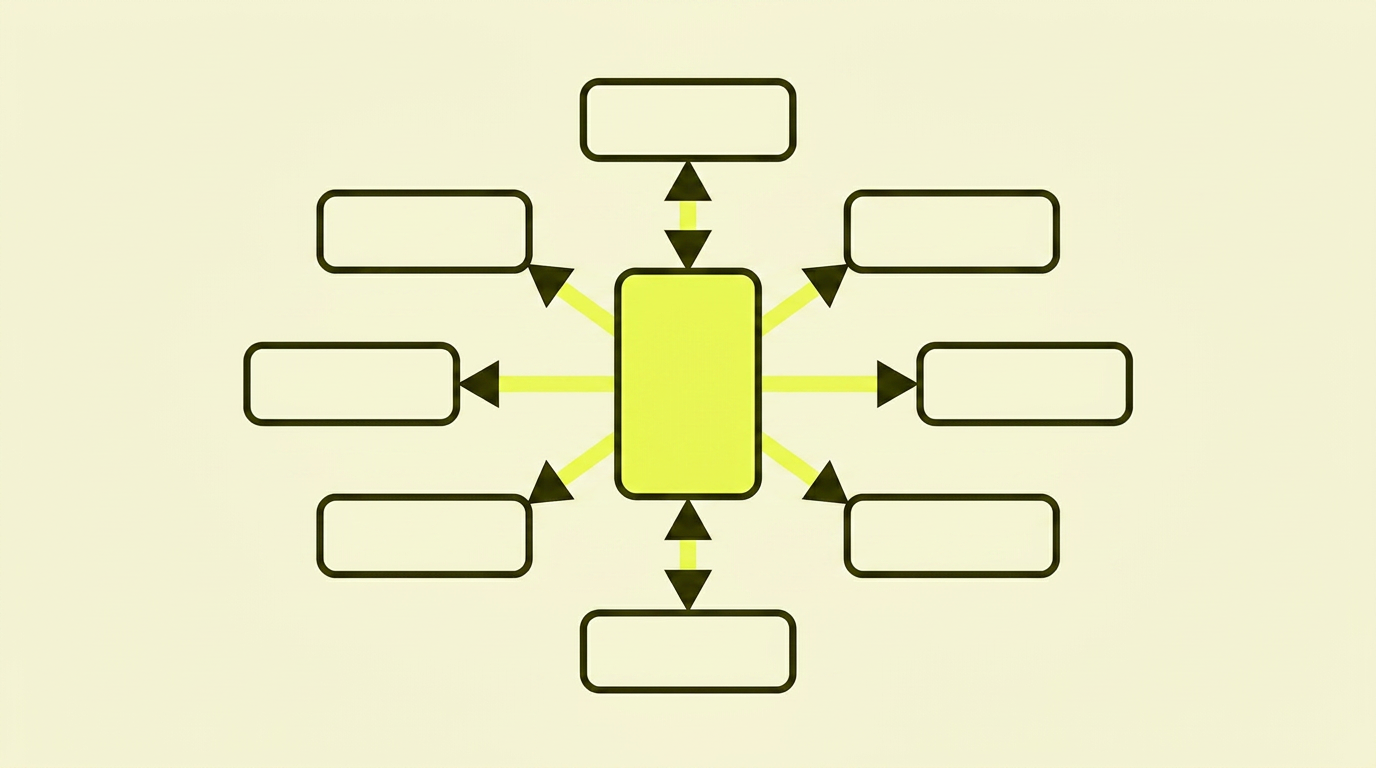
The simplest, most effective structure for SEO content in 2026 is the pillar/cluster model. Here's what it looks like:
The pillar is a comprehensive main article covering a broad topic (for example, 'A Guide to Technical SEO'). It targets the broadest keyword you're aiming for, provides an overview, and links out to more in-depth articles.
The cluster is a set of specific sub-articles, each covering a niche question (for example robots.txt, sitemap.xml and canonicals). Each cluster article links back to the pillar, and the pillar links to all the cluster articles.
The result is a network of pages that reinforce each other, both for readers and for Google.
What the URL Structure Should Look Like
The structure in your head should be mirrored in your URLs. The pillar sits one level up, the cluster articles sit beneath it. Here's the pattern:
smaaseo.com/tips/content                       ← pillar: content
smaaseo.com/tips/content/content-strategy      ← cluster article
smaaseo.com/tips/content/keyword-research      ← cluster article
smaaseo.com/tips/content/e-e-a-t               ← cluster article

smaaseo.com/tips/technical-seo                 ← pillar: technical SEO
smaaseo.com/tips/technical-seo/robots-txt      ← cluster article
smaaseo.com/tips/technical-seo/sitemap-xml     ← cluster article
A few simple rules that keep the structure clean:
- No more than two levels below the section.
/tips/content/content-strategyis readable./tips/blog/2026/07/content/strategy-part-1is not. - Words, not numbers. The URL should be readable out loud and make sense on its own.
- One topic per folder. If an article could just as easily live in two folders, your topic split is too vague.
- Pick trailing slash or no trailing slash, and stick to it. See trailing slash and canonical for why it matters.
- If you change the structure, redirect everything. Old URLs must point to the new ones with 301 redirects, or you lose what you've built.
How to Build the Strategy, Step by Step
Here is the short version of the process I use with clients:
1. Map Your Business Goals First
Content strategy that isn't tied to business goals is academic. Start with the question: which services or products are most profitable, and who are the right customers? Everything else flows from this.
2. Map Your Audience's Searches
Start with a proper keyword research pass — you don't need expensive tools to get going. Google Search Console, Google Autocomplete and the 'People also ask' box take you surprisingly far. The goal is to find the words and questions your target audience actually types.
Don't guess. Data beats guesswork.
3. Group into Topics
Take the keywords you've found and group them into 5 to 10 main topics. Each topic should have:
- One broad keyword for the pillar.
- 5 to 15 niche keywords for the sub-articles.
This is the rough draft of your content plan.
4. Prioritise by Volume × Relevance × Competition
Not all topics are equally valuable. Prioritise where three things meet:
- Volume: enough searches to be worth your time.
- Relevance: directly linked to what you sell.
- Competition: realistic to compete for, given your current authority.
If you have a new site, don't aim for 'SEO' as your first article. Aim for long, specific search queries where you can actually win within six months.
5. Create an Editorial Plan
One row per article with: title, primary keyword, secondary keywords, target audience, purpose, planned length, publishing date, and person responsible. A simple Google Sheets tab will do. The tool isn't the point; the discipline is.
6. Write, Publish, Measure, Update
Write so both people and search engines get your point: see how to write SEO copy, give every article a meta title and meta description that earns the click, and close with a CTA that actually converts. If you also want the content picked up by AI answers, GEO and E-E-A-T are what decide it. Using AI in production? I've collected the prompts I actually use.
Publish in the order your plan dictates. After 3 to 6 months, go back and update the oldest articles based on what Search Console shows: what keywords are they ranking for that you didn't know about, what's missing, where are you losing clicks?
Existing Content Is a Resource
One of the most surprising insights I share with new clients is that old content is often the fastest route to more traffic.
Pages already ranking in positions 5 to 15 can often be pushed into the top 3 with a few hours of work: updating figures, adding a missing section, improving the meta title and meta description, and adding internal links. It's much cheaper than writing a new article from scratch.
Common Mistakes I See
- The 'blog' with no theme. One article about product news, one about the office Christmas party, one about 'industry trends'. No thematic thread, no authority being built.
- Writing before research. You get started, only to discover three weeks later that nobody is searching for the topic.
- No internal linking structure. The articles exist in isolation, without internal links to tie them together.
- Publish once, then forget. No updates, no follow-up. The content slowly decays.
- Copying a competitor's strategy 1:1. Without considering their strengths, you end up with a poor imitation.
Case Study: From a Scattered Blog to a Cluster Strategy
A B2B services client had 120 blog posts from the last five years. Organic traffic had flatlined at 400 sessions per month.
The problem: The posts were about everything from HR to software to New Year's resolutions, with no connection between them. Fewer than 10 of them ranked in positions 1 to 10 for any relevant keyword.
The action: We identified the three core topics tied to their services. We deleted 40 of the most outdated posts (and set up 301 redirects to the nearest relevant page). We wrote three pillar articles and updated 25 existing posts to become a thematic cluster under each pillar. We added an internal linking structure.
The result: After six months, organic traffic was up to 1,800 sessions per month. After twelve months, it was 4,200. No extra technical optimisation, no bought links—just strategy and structure.
How to Measure If Your Strategy Is Working
Three key metrics that tell you if you're on the right track. Pull the traffic numbers from GA4 and the rankings from Search Console:
- Organic traffic over 90 days. It should grow steadily, not in sudden leaps.
- Number of pages ranking in the top 10. This should increase month by month.
- Share of your target keywords where you're visible. This should creep upwards quarter by quarter.
Don't evaluate the strategy until at least 3 months have passed. SEO is slow at the beginning and steep later on.
Your Action Plan: Step-by-Step
| Step | What to do |
|---|---|
| 1 | Write down the three most important business goals for your website. |
| 2 | Map 30 to 50 keywords from Search Console and Google Autocomplete. |
| 3 | Group them into 3 to 5 main topics, each with one pillar. |
| 4 | Mark the five most important and realistic pillars. |
| 5 | Create an editorial plan with at least 12 articles for the next 3 months. |
| 6 | Publish in a logical order, not randomly. |
| 7 | After three months, review Search Console and find candidates for updating. |
| 8 | Repeat quarterly. The strategy is a living document, not a one-off project. |
In Summary: My Take on Content Strategy
Content strategy isn't glamorous, but it's perhaps the single most important factor for long-term SEO success. Without a strategy, you're working hard but building nothing. With a strategy, each article supports the next, and after a year and a half, you have an asset that continues to deliver traffic long after the money you spent on ads is gone.
Start small: one pillar, three cluster articles, one month's work. See it work. Scale from there.